AdSense Rejected My Site Twice for Low-Value Content: What I’m Changing
Google rejected AI Workbench Lab twice for low-value content. Here is what changed between reviews, what still was not enough, and the content-quality work I am doing before trying again.
When I first prepared AI Workbench Lab for Google AdSense, I focused on the things that looked obviously necessary.
I added:
- an About page
- a Contact page
- a Privacy Policy
- Terms
- a Cookie Policy
- clear navigation
- an AdSense verification script
The site ownership check passed.
The review was submitted.
Then the result arrived:
Low-value content.
That was useful feedback because it forced me to stop asking:
"Is the site technically ready for AdSense?"
and ask a harder question:
"Is the site useful enough that a reviewer can immediately see why it should exist?"
Those are not the same question.
Update: the second review was rejected too
I made meaningful changes after the first rejection.
The site went from 23 blog posts to 18 after overlapping pages were consolidated. I strengthened the practical resources, kept the legal and contact pages, added the correct ads.txt record, removed an unfinished newsletter signup area, and fixed stale hardcoded content counts.
Then I requested another review.
On 31 October 2026, Google rejected the site again.
The policy panel showed the same core reason:
Low-value content.
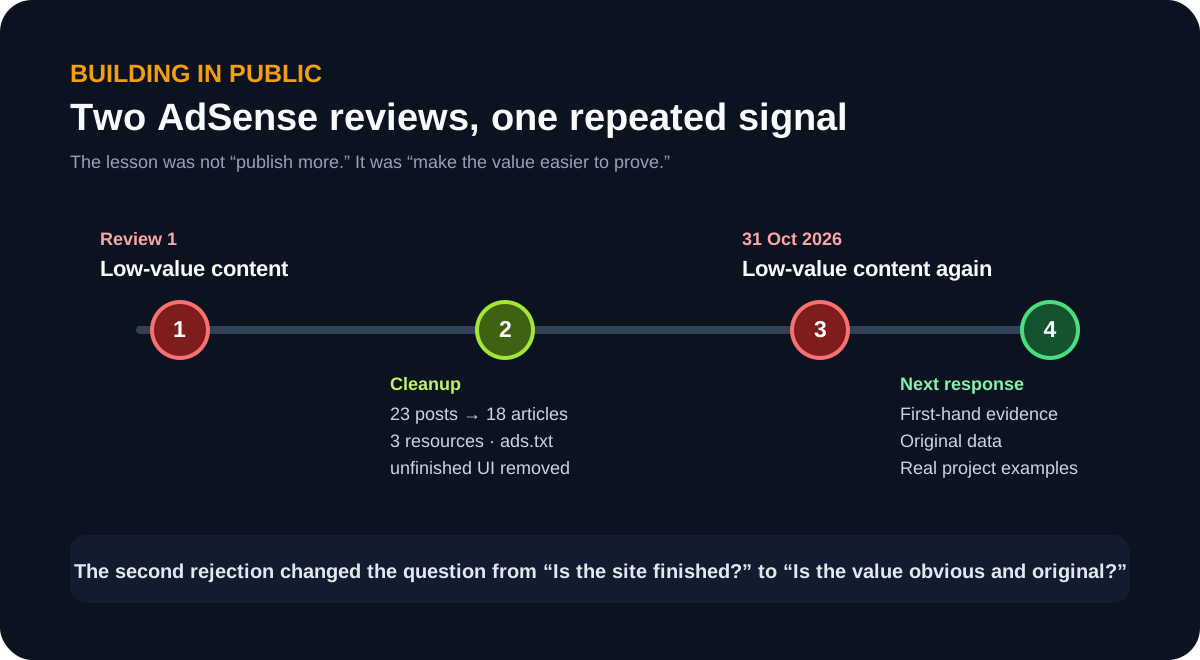
That second rejection changed my diagnosis.
The first time, I could reasonably suspect that duplication, unfinished presentation, or basic site readiness were the main problems.
The second time, those obvious issues had already been addressed.
So the question became more specific:
Does each important page show enough firsthand evidence, original analysis, or practical usefulness to make the site's value obvious?
That is now the focus of the next cleanup.
What AdSense actually flagged on my site
The AdSense review did not say the code was missing.
It did not say site ownership failed.
The policy panel showed a content-quality problem.
In my case, Google highlighted the need for a site to provide enough original value, maintain its content properly, and demonstrate genuine user interest.
That meant the next step was not adding another script or changing a technical setting.
It was reviewing the content itself.
I audited every article instead of publishing more
At the time of the review, AI Workbench Lab had 23 blog posts.
At first, that number felt reassuring.
Twenty-three posts did not sound like a thin website.
But article count was the wrong metric.
When I reviewed the posts side by side, a different picture appeared.
Some pages were strong and specific:
- a real Blogger-to-Next.js migration checklist
- my actual Cursor workflow
- how I learned to stop wasting v0 credits
- Vercel Preview vs Production troubleshooting
- Supabase authentication and redirect problems
- a real backend/Auth/RLS decision
- my practical AI website stack
Those pages answered identifiable questions and came from work I had actually done.
Other pages were weaker.
They repeated similar personal lessons:
- start before you feel ready
- do not chase perfection
- AI changed the way I think
- AI cost time before it saved time
- I spent too long choosing a platform
Each article was sincere.
The problem was that several of them delivered almost the same value.
The biggest issue I found: repetition
One example was my Blogger-versus-WordPress content.
I had three different posts explaining why I chose Blogger.
A fourth post repeated much of the same lesson through a "biggest website mistake" story.
Individually, none of those pages was terrible.
Together, they created unnecessary duplication.
That is exactly the kind of thing a site owner can miss when articles are published over time.
You remember the story behind each post.
A reviewer sees four URLs asking for attention.
So I changed the goal.
Instead of preserving every article because I had already written it, I started asking:
Which version gives the reader the most complete answer?
The weaker pages are now being merged into one stronger article, with permanent redirects from the old URLs.
I found the same problem in my personal-growth articles
Several early posts were about confidence, perfection, time, and starting.
Those ideas were part of my real experience.
But they did not need to exist as separate short pages.
The useful parts are being consolidated into the main build-in-public story.
That keeps the personal side of the site without turning the blog into a collection of similar motivational essays.
For me, that distinction matters.
AI Workbench Lab is supposed to be about:
practical AI + real projects + reusable lessons
not generic motivation with AI mentioned around it.
What I am keeping
The strongest pages share several traits.
They contain at least one of these:
- a real project decision
- a problem I actually encountered
- a step-by-step workflow
- a troubleshooting process
- a checklist
- a comparison based on firsthand use
- a concrete mistake and the fix
- a practical resource the reader can use immediately
For example, my Cursor workflow explains the process I now use after accepting too many broad AI edits.
My v0 workflow comes from wasting credits while changing direction during generation.
My website migration guide comes directly from moving AI Workbench Lab off Blogger.
Those pages are closer to what I want the whole site to become.
What I am changing
My cleanup has five parts.
1. Merge overlapping articles
When several pages are substantially about the same experience, I am choosing the strongest destination and combining the useful material there.
The old URLs get permanent redirects rather than becoming dead links.
2. Rewrite generic pages around a practical user problem
A broad opinion like:
"Businesses need to keep improving their websites"
is not enough by itself.
A more useful page is:
"Your new website is not getting Google traffic yet — here are the checks I use after launch."
The second version gives the reader something to do.
3. Keep technical articles grounded in real work
I do not want AI Workbench Lab to become a catalogue of tools I have never used.
If I write about Cursor, v0, Vercel, Supabase, Search Console, or migration, I want the article to include what happened when I used it.
4. Reduce page count when reduction improves the site
This was probably the most important mindset change.
I used to think a growing blog should always have more pages.
Now I would rather have 14 strong pages than 23 pages with repeated ideas.
More URLs are not automatically more value.
5. Improve the path between articles and resources
The site already has practical resources such as:
The articles should naturally lead to those resources when they help the reader take the next step.
That makes the site more useful than a collection of isolated posts.
What I am not doing
I am not immediately clicking "request review" again.
The point is not to make a few cosmetic edits and send the same site back.
I want the next version of the site to be materially better.
That means:
- consolidate duplicate content
- rewrite weak pages
- verify redirects
- check internal links
- confirm the sitemap contains only useful canonical pages
- verify the Production build
- let the cleaned site be crawled again
- then request another AdSense review
What surprised me most
The biggest surprise was that the AdSense rejection was not mainly a monetisation problem.
It exposed a publishing problem.
I had been thinking like the person who created the articles.
Google forced me to look at the site like someone arriving for the first time.
Would a new visitor see:
23 separate useful reasons to visit?
Or would they see:
a smaller number of strong ideas repeated across too many URLs?
That is a much better question.
A simple low-value-content audit I would use again
If I were reviewing another small content site, I would go through every public page and classify it:
KEEP
The page is specific, original, and useful.
IMPROVE
The topic is worth keeping, but the article needs stronger firsthand evidence, clearer intent, or more practical value.
MERGE
The useful material belongs inside a stronger page covering the same idea.
REMOVE
There is no strong user reason for the page to exist and no good equivalent to consolidate it into.
Then I would check:
- Are several titles targeting almost the same intent?
- Are multiple articles repeating the same personal lesson?
- Does each page solve a recognisable problem?
- Is there first-hand evidence where I claim experience?
- Does the page lead naturally to a useful next step?
- Would I still publish this page if article count did not matter?
That last question is especially useful.
The lesson I am taking from the rejection
I still want AI Workbench Lab to grow.
But I no longer want growth to mean "publish more."
I want it to mean:
publish something new only when it adds a new reason to visit.
That is a much higher standard.
It is also a better one.
I do not know yet whether the next AdSense review will approve the site.
This article is being written while the cleanup is still happening.
But the first rejection already improved the project because it made the content strategy clearer.
The goal is no longer to look ready for monetisation.
The goal is to build a site worth monetising.
Practical AI. Real Experience. Built in Public.